National 5 Applications of Maths formula sheet (SQA)
In SQA National 5 Applications of Mathematics exams in Scotland you get a formulae list: circumference and area of a circle, Pythagoras, the volumes of a cylinder, prism, cone and sphere, standard deviation and gradient. This free sheet shows all of it, plus the formulae you must learn: 26 formula groups on 4 A4 pages.
- SQA National 5 Apps (Scotland)
- 4 A4 pages
- 17 to learn
- Checked 21 October 2026
PDF · 53 KB · prints at actual size on A4 · original revision aid, not the official SQA formulae list
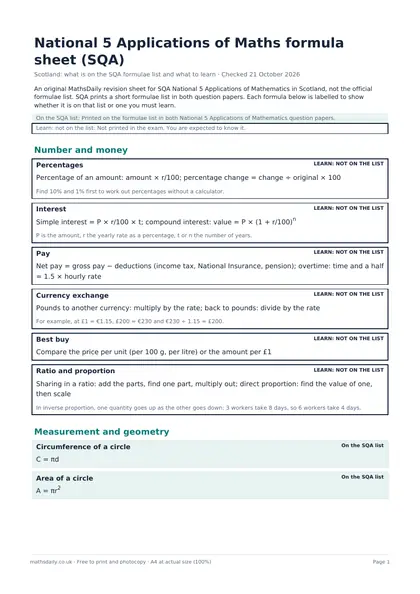
What is on the National 5 Applications of Maths formulae list?
SQA prints the same short list at the front of both National 5 Applications of Mathematics papers:
- Circumference of a circle: C = πd
- Area of a circle: A = πr2
- Theorem of Pythagoras: a2 + b2 = c2
- Gradient: Gradient = vertical height ÷ horizontal distance
- Volume of a cylinder: V = πr2h
- Volume of a prism: V = Ah
- Volume of a cone: V = ⅓πr2h
- Volume of a sphere: V = (4/3)πr3
- Standard deviation: s = √( Σ(x − x̄)2 / (n − 1) ) or s = √( (Σx2 − (Σx)2/n) / (n − 1) ), where n is the sample size
That is all. Percentages, interest, pay, currency exchange, best buys, ratio, units, tolerance, scale and bearings, speed, distance and time, averages, quartiles and probability are not on the list, so you must learn them.
How the labels work
- On the SQA listPrinted on the formulae list in both National 5 Applications of Mathematics question papers.
- Learn: not on the listNot printed in the exam. You are expected to know it.
Number and money
Percentages
Learn: not on the listPercentage of an amount: amount × r/100; percentage change = change ÷ original × 100
Find 10% and 1% first to work out percentages without a calculator.
Interest
Learn: not on the listSimple interest = P × r/100 × t; compound interest: value = P × (1 + r/100)n
P is the amount, r the yearly rate as a percentage, t or n the number of years.
Pay
Learn: not on the listNet pay = gross pay − deductions (income tax, National Insurance, pension); overtime: time and a half = 1.5 × hourly rate
Currency exchange
Learn: not on the listPounds to another currency: multiply by the rate; back to pounds: divide by the rate
For example, at £1 = €1.15, £200 = €230 and €230 ÷ 1.15 = £200.
Best buy
Learn: not on the listCompare the price per unit (per 100 g, per litre) or the amount per £1
Ratio and proportion
Learn: not on the listSharing in a ratio: add the parts, find one part, multiply out; direct proportion: find the value of one, then scale
In inverse proportion, one quantity goes up as the other goes down: 3 workers take 8 days, so 6 workers take 4 days.
Measurement and geometry
Circumference of a circle
On the SQA listC = πd
Area of a circle
On the SQA listA = πr2
Theorem of Pythagoras
On the SQA lista2 + b2 = c2
c is the hypotenuse, the longest side, opposite the right angle.
Gradient
On the SQA listGradient = vertical height ÷ horizontal distance
Area of rectangles and triangles
Learn: not on the listRectangle: A = lb; triangle: A = ½bh
Split composite shapes into rectangles, triangles and parts of circles.
Units
Learn: not on the list1 m = 100 cm; 1 km = 1000 m; 1 kg = 1000 g; 1 litre = 1000 ml = 1000 cm3; 1 m3 = 1000 litres
Tolerance
Learn: not on the list25 ± 0.5 mm means anything from 24.5 mm to 25.5 mm is acceptable
Scale drawings and bearings
Learn: not on the listReal length = drawing length × scale factor; bearings are three figures, measured clockwise from north
The bearing back is the original bearing ± 180°.
Volume
Volume of a cylinder
On the SQA listV = πr2h
Volume of a prism
On the SQA listV = Ah
A is the area of the cross-section.
Volume of a cone
On the SQA listV = ⅓πr2h
Volume of a sphere
On the SQA listV = (4/3)πr3
Volume of a cuboid
Learn: not on the listV = lbh
Time and speed
Speed, distance and time
Learn: not on the listSpeed = distance ÷ time; distance = speed × time; time = distance ÷ speed
Convert minutes to hours by dividing by 60: 45 minutes = 0.75 hours.
Time intervals
Learn: not on the listCount on in steps to the next hour, then to the end time; use the 24-hour clock across midnight
Statistics and probability
Standard deviation
On the SQA lists = √( Σ(x − x̄)2 / (n − 1) ) or s = √( (Σx2 − (Σx)2/n) / (n − 1) ), where n is the sample size
A smaller standard deviation means the data is more consistent.
Averages and range
Learn: not on the listMean = total ÷ number of values; median = middle value; mode = most common; range = largest − smallest
See the mean, median, mode and range guide.
Quartiles
Learn: not on the listQ1, Q2 (the median) and Q3 split ordered data into quarters; interquartile range = Q3 − Q1; semi-interquartile range = (Q3 − Q1) / 2
Quartiles are used to draw box plots.
Probability
Learn: not on the listP(event) = number of favourable outcomes ÷ total number of outcomes; expected frequency = probability × number of trials
Scatter graphs
Learn: not on the listDraw a line of best fit through the middle of the points, then use it to estimate values
Describe the correlation as positive, negative or none.
Formulae to learn
These are not on the SQA formulae list. The last page of the PDF has the same list as tick-boxes.
- Percentages
- Interest
- Pay
- Currency exchange
- Best buy
- Ratio and proportion
- Area of rectangles and triangles
- Units
- Tolerance
- Scale drawings and bearings
- Volume of a cuboid
- Speed, distance and time
- Time intervals
- Averages and range
- Quartiles
- Probability
- Scatter graphs
Official sources
Checked on 21 October 2026 against the formulae list SQA prints in National 5 Applications of Mathematics question papers. Always check a recent past paper.
- SQA: National 5 Applications of Mathematics Paper 1 formulae list (X844/75/01, 2022)
- SQA: National 5 Applications of Mathematics Paper 2 formulae list, 2026
- SQA: past papers and marking instructions
National 5 Applications of Maths past papers
SQA publishes National 5 Applications of Mathematics past papers and their marking instructions free on its past papers and marking instructions page. Print this sheet, work through a past paper without looking, then tick off any formula you needed but could not remember.
Practise the methods
MathsDaily follows the curriculum in England, so it has no National 5 level. These guides cover many of the same skills:
Common questions
Do you get a formula sheet in National 5 Applications of Maths?
Yes. SQA prints a formulae list at the front of both National 5 Applications of Mathematics question papers, the non-calculator Paper 1 and the calculator Paper 2.
What is on the National 5 Applications of Maths formulae list?
Circumference and area of a circle, the theorem of Pythagoras, the volumes of a cylinder, prism, cone and sphere, both forms of the standard deviation formula, and gradient as vertical height divided by horizontal distance.
Which formulae do I need to learn?
17 of the 26 formula groups on this page are not on the list, including percentages, simple and compound interest, net pay, currency exchange, best buys, ratio, unit conversions, tolerance, bearings, speed, distance and time, averages, quartiles and probability. The last page of the PDF is a tick-list.
How is Applications of Maths different from National 5 Maths?
Applications of Mathematics focuses on using maths in real situations: money, measurement, statistics and planning. National 5 Mathematics has more algebra and trigonometry. They have different formulae lists, so check which course you are sitting. See the National 5 Maths formula sheet for the other course.
Is this the official SQA formulae list?
No. It is an original MathsDaily revision sheet that shows what the official list contains and what it leaves out. In the exam you use the list printed in your question paper.