GCSE Higher maths worksheet
GCSE Higher: 24 exam-style questions, 12 non-calculator and 12 calculator, covering indices, surds, quadratics, functions, trigonometry, proportion, bounds, circle theorems and probability at grades 4–9. Free A4 PDF with answer boxes and a worked answer key.
- GCSE Higher
- 24 questions
- 6 A4 pages
- Worked answer key
- Non-calculator and calculator sections
PDF · 59 KB · prints at actual size on A4 · questions on pages 1–3, answers on pages 4–6
What the worksheet covers
- Fractional and negative indices
- Surds
- Factorising and solving quadratics
- Completing the square
- Functions and inverses
- Sine and cosine rules
- Proportion and growth
- Bounds, circles and probability
The questions are grouped into sections that move from fluency to reasoning and problem solving. Each question has its own answer box and space for working, and the answer key explains the method rather than giving the answer alone.
Worked example
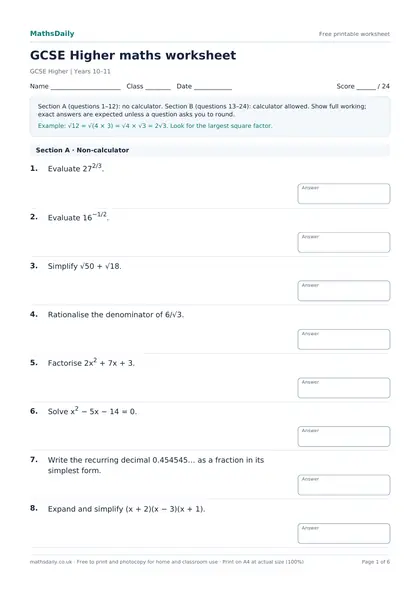
Example: √12 = √(4 × 3) = √4 × √3 = 2√3. Look for the largest square factor.
The example on the worksheet is separate from the 24 questions, so it never gives an answer away.
Sample questions
- Evaluate 272/3.
- Evaluate 16−1/2.
- Simplify √50 + √18.
- Rationalise the denominator of 6/√3.
Show answers to the sample questions
- 9. Take the cube root first: ∛27 = 3. Then square: 32 = 9.
- 1/4. A negative index means a reciprocal: 1 ÷ 161/2 = 1 ÷ 4 = 1/4.
- 8√2. √50 = √25 × √2 = 5√2 and √18 = √9 × √2 = 3√2. So 5√2 + 3√2 = 8√2.
- 2√3. Multiply the top and bottom by √3: 6√3/3 = 2√3.
How to use it
- Print pages 1–3 for the learner and keep pages 4–6 (the answer key) for marking.
- Read the instructions box: Section A (questions 1–12): no calculator. Section B (questions 13–24): calculator allowed. Show full working; exact answers are expected unless a question asks you to round.
- Work through the sections in order, showing working in the space and writing each final answer in its box.
- Mark with the worked answer key, talk through any mistakes, then retry those questions a few days later.
Printing tips
- Paper and scaleA4, portrait, scale set to “actual size” or 100%, not “fit to page”.
- Black and whiteThe light layout is designed for greyscale printing and photocopying.
- Questions onlyChoose pages 1–3 in the print dialog to keep the answers separate.
- Phones and tabletsOpen the PDF, then use Share › Print (iPhone and iPad) or the menu › Print (Android).
Keep practising
Start GCSE Higher Daily 10 Maths →Related worksheets
Topic guides
Curriculum alignment
Topics follow the GCSE subject content set by the Department for Education, which all exam boards use. This worksheet is selected practice, not a complete test of the year or course.
Common questions
Is this worksheet free?
Yes. The GCSE Higher maths worksheet is free to download, print and photocopy for home or classroom use. There is no sign-up and no watermark.
Are the answers included?
Yes. Pages 1–3 are the questions and pages 4–6 are a worked answer key with the method for every question, so you can print the questions on their own.
How do I print it at the right size?
Use Print on this page, or open the PDF and print on A4 paper in portrait with the scale set to actual size or 100%, not “fit to page”. It prints clearly in black and white.