A-level Maths formula sheet
Pure mathematics, statistics and mechanics: 39 formula groups on 5 A4 pages, each labelled to show whether it is printed in the AQA and Edexcel exam booklets or must be learned. Includes conditions, common pitfalls and a learn-it checklist.
- A-level Maths
- 5 A4 pages
- 21 to learn
- Checked 11 October 2026
PDF · 61 KB · prints at actual size on A4 · original revision aid, not an official exam booklet
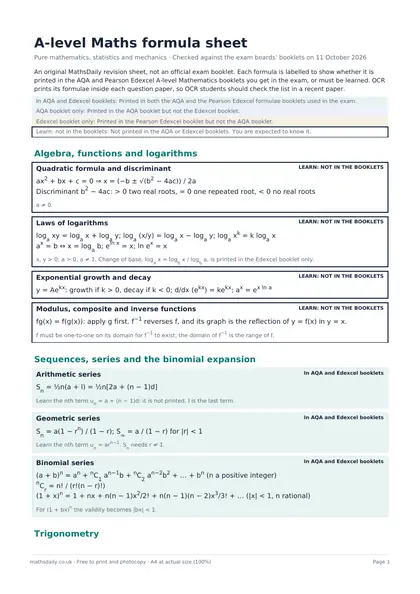
How the labels work
- In AQA and Edexcel bookletsPrinted in both the AQA and the Pearson Edexcel formulae booklets used in the exam.
- AQA booklet onlyPrinted in the AQA booklet but not the Edexcel booklet.
- Edexcel booklet onlyPrinted in the Pearson Edexcel booklet but not the AQA booklet.
- Learn: not in the bookletsNot printed in the AQA or Edexcel booklets. You are expected to know it.
Algebra, functions and logarithms
Quadratic formula and discriminant
Learn: not in the bookletsax2 + bx + c = 0 ⇒ x = (−b ± √(b2 − 4ac)) / 2a
Discriminant b2 − 4ac: > 0 two real roots, = 0 one repeated root, < 0 no real roots
a ≠ 0.
Laws of logarithms
Learn: not in the bookletsloga xy = loga x + loga y; loga (x/y) = loga x − loga y; loga xk = k loga x
ax = b ⇔ x = loga b; eln x = x; ln ex = x
x, y > 0; a > 0, a ≠ 1. Change of base, loga x = logb x / logb a, is printed in the Edexcel booklet only.
Exponential growth and decay
Learn: not in the bookletsy = Aekx: growth if k > 0, decay if k < 0; d/dx (ekx) = kekx; ax = ex ln a
Modulus, composite and inverse functions
Learn: not in the bookletsfg(x) = f(g(x)): apply g first. f−1 reverses f, and its graph is the reflection of y = f(x) in y = x.
f must be one-to-one on its domain for f−1 to exist; the domain of f−1 is the range of f.
Sequences, series and the binomial expansion
Arithmetic series
In AQA and Edexcel bookletsSn = ½n(a + l) = ½n[2a + (n − 1)d]
Learn the nth term un = a + (n − 1)d: it is not printed. l is the last term.
Geometric series
In AQA and Edexcel bookletsSn = a(1 − rn) / (1 − r); S∞ = a / (1 − r) for |r| < 1
Learn the nth term un = arn−1. Sn needs r ≠ 1.
Binomial series
In AQA and Edexcel booklets(a + b)n = an + nC1 an−1b + nC2 an−2b2 + … + bn (n a positive integer)
nCr = n! / (r!(n − r)!)
(1 + x)n = 1 + nx + n(n − 1)x2/2! + n(n − 1)(n − 2)x3/3! + … (|x| < 1, n rational)
For (1 + bx)n the validity becomes |bx| < 1.
Trigonometry
Sine rule, cosine rule and area
Learn: not in the bookletsa/sin A = b/sin B = c/sin C; a2 = b2 + c2 − 2bc cos A; Area = ½ab sin C
Side a is opposite angle A.
Radians: arc length and sector area
Learn: not in the bookletss = rθ; A = ½r2θ; π radians = 180°
θ in radians.
Pythagorean identities
Learn: not in the bookletssin2θ + cos2θ = 1; 1 + tan2θ = sec2θ; 1 + cot2θ = cosec2θ; tan θ = sin θ / cos θ
Compound-angle formulae
In AQA and Edexcel bookletssin(A ± B) = sin A cos B ± cos A sin B
cos(A ± B) = cos A cos B ∓ sin A sin B
tan(A ± B) = (tan A ± tan B) / (1 ∓ tan A tan B)
tan form needs A ± B ≠ (k + ½)π.
Double-angle formulae
Learn: not in the bookletssin 2A = 2 sin A cos A; cos 2A = cos2A − sin2A = 2cos2A − 1 = 1 − 2sin2A; tan 2A = 2 tan A / (1 − tan2A)
Derived from the compound-angle formulae with B = A.
Harmonic form
Learn: not in the bookletsa sin θ + b cos θ = R sin(θ + α), where R = √(a2 + b2), tan α = b/a
Similar forms exist for R cos(θ ± α); choose the form the question asks for.
Small-angle approximations
In AQA and Edexcel bookletssin θ ≈ θ; cos θ ≈ 1 − θ2/2; tan θ ≈ θ
θ small and in radians.
Differentiation
Standard derivatives
Learn: not in the bookletsxn → nxn−1; ekx → kekx; ln x → 1/x; sin kx → k cos kx; cos kx → −k sin kx; ax → ax ln a
Trigonometric results require radians.
Further derivatives
In AQA and Edexcel bookletstan kx → k sec2kx; sec x → sec x tan x; cosec x → −cosec x cot x; cot x → −cosec2x
First principles
In AQA and Edexcel bookletsf′(x) = limh→0 [f(x + h) − f(x)] / h
Product and chain rules
AQA booklet onlyd/dx (uv) = u dv/dx + v du/dx; dy/dx = (dy/du)(du/dx)
The Edexcel booklet does not print these: Edexcel students must learn them.
Quotient rule
In AQA and Edexcel bookletsd/dx (u/v) = (v du/dx − u dv/dx) / v2
v ≠ 0.
Parametric and implicit differentiation
Learn: not in the bookletsdy/dx = (dy/dt) / (dx/dt); d/dx [f(y)] = f′(y) dy/dx
dx/dt ≠ 0.
Stationary points
Learn: not in the bookletsdy/dx = 0 at a stationary point; d2y/dx2 > 0 minimum, < 0 maximum (test further if = 0). Point of inflection: d2y/dx2 changes sign.
Integration and numerical methods
Standard integrals
Learn: not in the booklets∫xn dx = xn+1/(n + 1) + c (n ≠ −1); ∫1/x dx = ln|x| + c; ∫ekx dx = ekx/k + c; ∫cos kx dx = (1/k) sin kx + c; ∫sin kx dx = −(1/k) cos kx + c; ∫sec2kx dx = (1/k) tan kx + c
Integration by parts
In AQA and Edexcel booklets∫u (dv/dx) dx = uv − ∫v (du/dx) dx
Integrals of f′/f, tan and cot
AQA booklet only∫f′(x)/f(x) dx = ln|f(x)| + c; ∫tan x dx = ln|sec x| + c; ∫cot x dx = ln|sin x| + c
The Edexcel booklet prints tan, cot, sec and cosec integrals but not the f′/f result.
Area and definite integrals
Learn: not in the bookletsArea = ∫ab y dx; area between curves = ∫ab (upper − lower) dx
Signed area is negative below the x-axis: split at roots for total area.
Newton–Raphson
In AQA and Edexcel bookletsxn+1 = xn − f(xn) / f′(xn)
Can fail if f′(xn) is near 0 or the start is far from the root.
Trapezium rule
In AQA and Edexcel booklets∫ab y dx ≈ ½h[(y0 + yn) + 2(y1 + y2 + … + yn−1)], h = (b − a)/n
Overestimates for curves that are concave up (convex), underestimates for concave down.
Vectors
Learn: not in the booklets|ai + bj + ck| = √(a2 + b2 + c2); unit vector â = a/|a|; distance between points = |b − a|
Statistics
Probability
In AQA and Edexcel bookletsP(A ∪ B) = P(A) + P(B) − P(A ∩ B); P(A ∩ B) = P(A) P(B | A)
Independent: P(A ∩ B) = P(A) P(B). Mutually exclusive: P(A ∩ B) = 0.
Summary statistics
In AQA and Edexcel bookletsx̄ = Σx/n; σ = √(Σ(x − x̄)2/n) = √(Σx2/n − x̄2)
Edexcel also prints Sxx = Σ(x − x̄)2 = Σx2 − (Σx)2/n and IQR = Q3 − Q1. An outlier is often defined as more than 1.5 × IQR beyond a quartile; use the definition given.
Binomial distribution
In AQA and Edexcel bookletsX ~ B(n, p): P(X = x) = nCx px(1 − p)n−x; E(X) = np; Var(X) = np(1 − p)
Fixed n, independent trials, two outcomes, constant p.
Normal distribution
Learn: not in the bookletsX ~ N(μ, σ2): Z = (X − μ)/σ ~ N(0, 1)
σ is the standard deviation (the square root of the variance).
Distribution of the sample mean
In AQA and Edexcel bookletsFor a random sample of n from N(μ, σ2): X̄ ~ N(μ, σ2/n), so (X̄ − μ)/(σ/√n) ~ N(0, 1)
Hypothesis testing
Learn: not in the bookletsReject H0 when the p-value ≤ significance level (or the test statistic is in the critical region). Two-tailed tests split the significance level between tails.
Failing to reject H0 does not prove it is true. State conclusions in context.
Mechanics
Constant acceleration (SUVAT)
In AQA and Edexcel bookletsv = u + at; s = ut + ½at2; s = vt − ½at2; s = ½(u + v)t; v2 = u2 + 2as
Straight-line motion, constant a. Vector forms: v = u + at, r = ut + ½at2.
Variable acceleration
Learn: not in the bookletsv = ds/dt; a = dv/dt = d2s/dt2; s = ∫v dt; v = ∫a dt
Use limits or initial conditions to find constants.
Forces and Newton’s laws
Learn: not in the bookletsF = ma; W = mg; friction F ≤ μR, with F = μR when sliding or in limiting equilibrium
Take g = 9.8 m s−2 unless told otherwise.
Moments
Learn: not in the bookletsMoment = force × perpendicular distance from the pivot. In equilibrium: resultant force = 0 and total clockwise moment = total anticlockwise moment.
Projectiles
Learn: not in the bookletsHorizontal: x = (u cos θ)t. Vertical: y = (u sin θ)t − ½gt2; vy = u sin θ − gt
No air resistance; the horizontal velocity is constant.
Formulae to learn
These are not printed in the AQA or Edexcel booklets. The last page of the PDF has the same list as tick-boxes.
- Quadratic formula and discriminant
- Laws of logarithms
- Exponential growth and decay
- Modulus, composite and inverse functions
- Sine rule, cosine rule and area
- Radians: arc length and sector area
- Pythagorean identities
- Double-angle formulae
- Harmonic form
- Standard derivatives
- Parametric and implicit differentiation
- Stationary points
- Standard integrals
- Area and definite integrals
- Vectors
- Normal distribution
- Hypothesis testing
- Variable acceleration
- Forces and Newton’s laws
- Moments
- Projectiles
Official sources
Checked on 11 October 2026. Booklet versions are the ones the boards list as current; use the copy your board supplies in the exam.
- AQA: Formulae for A-level Mathematics (7356/7357), v1.2, August 2017
- AQA: Formulae and statistical tables for A-level Mathematics and Further Mathematics, v1.5, February 2018
- AQA: current formulae booklet versions
- Pearson Edexcel: Mathematical Formulae and Statistical Tables, Issue 1, July 2017 (A level Maths and Further Maths)
- OCR: AS and A Level Mathematics A (H230, H240): formulae are printed in each question paper
- Department for Education: AS and A level maths subject content, including formulae requirements
- Department for Education: AS and A level further maths subject content
Use the formulae in practice
Start A-level Daily 10 Maths →Common questions
Is this the official exam formulae booklet?
No. It is an original MathsDaily revision sheet. In the exam you use the booklet your board supplies; this sheet shows which formulae are in that booklet and which you must learn.
Which formulae do I need to learn?
21 of the 39 formula groups here are labelled “Learn: not in the booklets”. The final page of the PDF is a tick-list of them.
Does it cover OCR?
OCR prints its formulae on the inside pages of each question paper rather than in a separate booklet, so OCR students should check the list in a recent paper. Most of the “learn” formulae are the same.