Further Maths formula sheet
Core pure and selected optional statistics and mechanics: 28 formula groups on 5 A4 pages, each labelled to show whether it is printed in the AQA and Edexcel exam booklets or must be learned. Includes conditions, common pitfalls and a learn-it checklist.
- A-level Further Maths
- 5 A4 pages
- 14 to learn
- Checked 11 October 2026
PDF · 60 KB · prints at actual size on A4 · original revision aid, not an official exam booklet
How the labels work
- In AQA and Edexcel bookletsPrinted in both the AQA and the Pearson Edexcel formulae booklets used in the exam.
- AQA booklet onlyPrinted in the AQA booklet but not the Edexcel booklet.
- Edexcel booklet onlyPrinted in the Pearson Edexcel booklet but not the AQA booklet.
- Learn: not in the bookletsNot printed in the AQA or Edexcel booklets. You are expected to know it.
Further Maths builds on A-level Maths: revise the A-level Maths formula sheet too. Option content varies by board, so check which options you are taking.
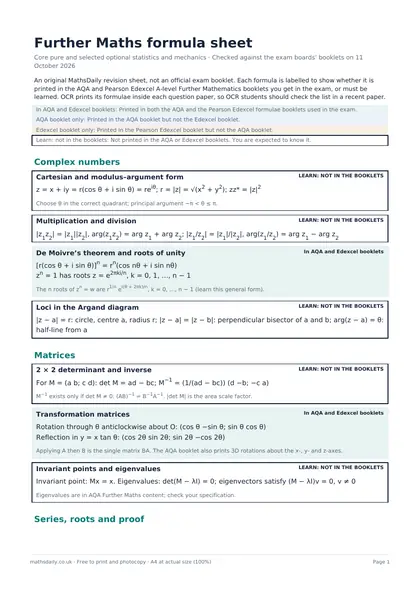
Complex numbers
Cartesian and modulus–argument form
Learn: not in the bookletsz = x + iy = r(cos θ + i sin θ) = reiθ; r = |z| = √(x2 + y2); zz* = |z|2
Choose θ in the correct quadrant; principal argument −π < θ ≤ π.
Multiplication and division
Learn: not in the booklets|z1z2| = |z1||z2|, arg(z1z2) = arg z1 + arg z2; |z1/z2| = |z1|/|z2|, arg(z1/z2) = arg z1 − arg z2
De Moivre’s theorem and roots of unity
In AQA and Edexcel booklets[r(cos θ + i sin θ)]n = rn(cos nθ + i sin nθ)
zn = 1 has roots z = e2πki/n, k = 0, 1, …, n − 1
The n roots of zn = w are r1/n ei(θ + 2πk)/n, k = 0, …, n − 1 (learn this general form).
Loci in the Argand diagram
Learn: not in the booklets|z − a| = r: circle, centre a, radius r; |z − a| = |z − b|: perpendicular bisector of a and b; arg(z − a) = θ: half-line from a
Matrices
2 × 2 determinant and inverse
Learn: not in the bookletsFor M = (a b; c d): det M = ad − bc; M−1 = (1/(ad − bc)) (d −b; −c a)
M−1 exists only if det M ≠ 0. (AB)−1 = B−1A−1. |det M| is the area scale factor.
Transformation matrices
In AQA and Edexcel bookletsRotation through θ anticlockwise about O: (cos θ −sin θ; sin θ cos θ)
Reflection in y = x tan θ: (cos 2θ sin 2θ; sin 2θ −cos 2θ)
Applying A then B is the single matrix BA. The AQA booklet also prints 3D rotations about the x-, y- and z-axes.
Invariant points and eigenvalues
Learn: not in the bookletsInvariant point: Mx = x. Eigenvalues: det(M − λI) = 0; eigenvectors satisfy (M − λI)v = 0, v ≠ 0
Eigenvalues are in AQA Further Maths content; check your specification.
Series, roots and proof
Standard sums
In AQA and Edexcel bookletsΣr=1n r2 = n(n + 1)(2n + 1)/6; Σr=1n r3 = n2(n + 1)2/4
Σr=1n r = n(n + 1)/2 is printed in the Edexcel booklet only.
Roots of polynomials
Learn: not in the bookletsax2 + bx + c: α + β = −b/a, αβ = c/a
ax3 + bx2 + cx + d: Σα = −b/a, Σαβ = c/a, αβγ = −d/a
a ≠ 0. Use substitution (e.g. w = 2x + 1) to form equations with transformed roots.
Method of differences and proof by induction
Learn: not in the bookletsIf ur = f(r) − f(r + 1), then Σr=1n ur = f(1) − f(n + 1).
Induction: prove the base case; assume true for n = k; prove for n = k + 1; conclude.
Maclaurin series
In AQA and Edexcel bookletsf(x) = f(0) + xf′(0) + x2f″(0)/2! + … + xrf(r)(0)/r! + …
ex = 1 + x + x2/2! + …; ln(1 + x) = x − x2/2 + x3/3 − … (−1 < x ≤ 1)
sin x = x − x3/3! + x5/5! − …; cos x = 1 − x2/2! + x4/4! − …
The Edexcel booklet also prints arctan x = x − x3/3 + x5/5 − … (−1 ≤ x ≤ 1).
Hyperbolic functions and further calculus
Hyperbolic definitions
Learn: not in the bookletssinh x = (ex − e−x)/2; cosh x = (ex + e−x)/2; tanh x = sinh x / cosh x
Learn these: the booklets give identities, not the definitions.
Hyperbolic identities and inverses
In AQA and Edexcel bookletscosh2x − sinh2x = 1
arsinh x = ln(x + √(x2 + 1)); arcosh x = ln(x + √(x2 − 1)) (x ≥ 1); artanh x = ½ ln((1 + x)/(1 − x)) (|x| < 1)
Inverse trigonometric and hyperbolic calculus
In AQA and Edexcel bookletsd/dx arcsin x = 1/√(1 − x2); d/dx arctan x = 1/(1 + x2); ∫1/(a2 + x2) dx = (1/a) arctan(x/a) + c; ∫1/√(a2 − x2) dx = arcsin(x/a) + c
Corresponding sinh, cosh and tanh results are printed too.
Volumes of revolution and mean value
Learn: not in the bookletsAbout the x-axis: V = π∫ab y2 dx; about the y-axis: V = π∫ x2 dy; mean value of f on [a, b] = (1/(b − a))∫ab f(x) dx
Polar coordinates
In AQA and Edexcel bookletsx = r cos θ, y = r sin θ; area = ½∫αβ r2 dθ
θ in radians. Only the area formula is printed; learn the conversions.
Arc length and surface area (option content)
In AQA and Edexcel bookletss = ∫√(1 + (dy/dx)2) dx; S = 2π∫y√(1 + (dy/dx)2) dx (about the x-axis)
Parametric forms are printed too.
Vectors and differential equations
Scalar product and angles
Learn: not in the bookletsa·b = |a||b| cos θ = a1b1 + a2b2 + a3b3; perpendicular ⇔ a·b = 0
The booklets use a·b in other results but do not state this definition.
Vector product, lines and planes
In AQA and Edexcel bookletsa × b = |a||b| sin θ n̂; line r = a + λb; plane r = a + λb + μc or r·n = a·n
Cartesian plane: n1x + n2y + n3z = d.
First-order linear equations
Learn: not in the bookletsdy/dx + P(x)y = Q(x): integrating factor I = e∫P dx; then d/dx (Iy) = IQ
Divide first so the coefficient of dy/dx is 1.
Second-order linear equations
Learn: not in the bookletsay″ + by′ + cy = 0, auxiliary equation am2 + bm + c = 0:
distinct real m1, m2: y = Aem₁x + Bem₂x; repeated m: y = (A + Bx)emx; m = p ± qi: y = epx(A cos qx + B sin qx)
For f(x) ≠ 0 add a particular integral to the complementary function.
Simple harmonic motion
Learn: not in the bookletsẍ = −ω2x ⇒ x = A cos ωt + B sin ωt; period T = 2π/ω; v2 = ω2(a2 − x2)
a is the amplitude.
Numerical methods
AQA booklet onlyEuler: yn+1 = yn + h f(xn, yn); Simpson’s rule (n even): ∫ab y dx ≈ (h/3)[y0 + 4(y1 + y3 + …) + 2(y2 + y4 + …) + yn]; mid-ordinate rule
Not in the Edexcel booklet.
Further statistics and mechanics (options)
Poisson distribution
In AQA and Edexcel bookletsX ~ Po(λ): P(X = x) = e−λλx/x!; E(X) = Var(X) = λ
Events occur singly, independently and at a constant average rate.
Chi-squared test
In AQA and Edexcel bookletsX2 = Σ(O − E)2/E; degrees of freedom: (rows − 1)(columns − 1) for contingency tables
Combine classes so each expected frequency is at least 5.
Work, energy and power
Learn: not in the bookletsWork = Fs cos θ; KE = ½mv2; GPE = mgh; power P = Fv
Work–energy principle: work done by non-conservative forces = change in mechanical energy.
Circular motion
Edexcel booklet onlyv = rω; acceleration towards centre = v2/r = rω2
Printed in the Edexcel booklet; AQA students must learn it.
Centres of mass
In AQA and Edexcel bookletsx̄ = Σmx/Σm; triangular lamina: ⅔ along median from vertex; solid hemisphere: 3r/8 from centre; solid cone: h/4 from base
Formulae to learn
These are not printed in the AQA or Edexcel booklets. The last page of the PDF has the same list as tick-boxes.
- Cartesian and modulus–argument form
- Multiplication and division
- Loci in the Argand diagram
- 2 × 2 determinant and inverse
- Invariant points and eigenvalues
- Roots of polynomials
- Method of differences and proof by induction
- Hyperbolic definitions
- Volumes of revolution and mean value
- Scalar product and angles
- First-order linear equations
- Second-order linear equations
- Simple harmonic motion
- Work, energy and power
Official sources
Checked on 11 October 2026. Booklet versions are the ones the boards list as current; use the copy your board supplies in the exam.
- AQA: Formulae for A-level Mathematics (7356/7357), v1.2, August 2017
- AQA: Formulae and statistical tables for A-level Mathematics and Further Mathematics, v1.5, February 2018
- AQA: current formulae booklet versions
- Pearson Edexcel: Mathematical Formulae and Statistical Tables, Issue 1, July 2017 (A level Maths and Further Maths)
- OCR: AS and A Level Mathematics A (H230, H240): formulae are printed in each question paper
- Department for Education: AS and A level maths subject content, including formulae requirements
- Department for Education: AS and A level further maths subject content
Use the formulae in practice
Start A-level Daily 10 Maths →Common questions
Is this the official exam formulae booklet?
No. It is an original MathsDaily revision sheet. In the exam you use the booklet your board supplies; this sheet shows which formulae are in that booklet and which you must learn.
Which formulae do I need to learn?
14 of the 28 formula groups here are labelled “Learn: not in the booklets”. The final page of the PDF is a tick-list of them.
Does it cover OCR?
OCR prints its formulae on the inside pages of each question paper rather than in a separate booklet, so OCR students should check the list in a recent paper. Most of the “learn” formulae are the same.