Higher Maths formula sheet (SQA)
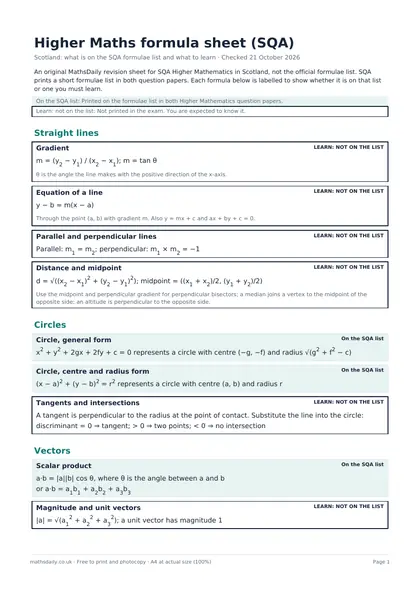
In SQA Higher Maths exams in Scotland you get a short formulae list: circles, the scalar product, the addition and double-angle formulae, and the derivatives and integrals of sin ax and cos ax. This free sheet shows all of it, plus the formulae you must learn: 26 formula groups on 4 A4 pages.
- SQA Higher (Scotland)
- 4 A4 pages
- 19 to learn
- Checked 21 October 2026
PDF · 54 KB · prints at actual size on A4 · original revision aid, not the official SQA formulae list
What is on the SQA Higher Maths formulae list?
SQA prints the same short list at the front of both Higher Mathematics papers:
- Circle, general form: x2 + y2 + 2gx + 2fy + c = 0 represents a circle with centre (−g, −f) and radius √(g2 + f2 − c)
- Circle, centre and radius form: (x − a)2 + (y − b)2 = r2 represents a circle with centre (a, b) and radius r
- Scalar product: a·b = |a||b| cos θ, where θ is the angle between a and b
or a·b = a1b1 + a2b2 + a3b3 - Addition formulae: sin(A ± B) = sin A cos B ± cos A sin B
cos(A ± B) = cos A cos B ∓ sin A sin B - Double-angle formulae: sin 2A = 2 sin A cos A
cos 2A = cos2A − sin2A = 2cos2A − 1 = 1 − 2sin2A - Standard derivatives: f(x) = sin ax ⇒ f′(x) = a cos ax; f(x) = cos ax ⇒ f′(x) = −a sin ax
- Standard integrals: ∫ sin ax dx = −(1/a) cos ax + c; ∫ cos ax dx = (1/a) sin ax + c
That is all. Straight lines, vectors beyond the scalar product, logarithms, recurrence relations, the wave function, exact values, the chain rule and integrating powers are not on the list, so you must learn them.
How the labels work
- On the SQA listPrinted on the formulae list in both Higher Mathematics question papers.
- Learn: not on the listNot printed in the exam. You are expected to know it.
Straight lines
Gradient
Learn: not on the listm = (y2 − y1) / (x2 − x1); m = tan θ
θ is the angle the line makes with the positive direction of the x-axis.
Equation of a line
Learn: not on the listy − b = m(x − a)
Through the point (a, b) with gradient m. Also y = mx + c and ax + by + c = 0.
Parallel and perpendicular lines
Learn: not on the listParallel: m1 = m2; perpendicular: m1 × m2 = −1
Distance and midpoint
Learn: not on the listd = √((x2 − x1)2 + (y2 − y1)2); midpoint = ((x1 + x2)/2, (y1 + y2)/2)
Use the midpoint and perpendicular gradient for perpendicular bisectors; a median joins a vertex to the midpoint of the opposite side; an altitude is perpendicular to the opposite side.
Circles
Circle, general form
On the SQA listx2 + y2 + 2gx + 2fy + c = 0 represents a circle with centre (−g, −f) and radius √(g2 + f2 − c)
Circle, centre and radius form
On the SQA list(x − a)2 + (y − b)2 = r2 represents a circle with centre (a, b) and radius r
Tangents and intersections
Learn: not on the listA tangent is perpendicular to the radius at the point of contact. Substitute the line into the circle: discriminant = 0 ⇒ tangent; > 0 ⇒ two points; < 0 ⇒ no intersection
Vectors
Scalar product
On the SQA lista·b = |a||b| cos θ, where θ is the angle between a and b
or a·b = a1b1 + a2b2 + a3b3
Magnitude and unit vectors
Learn: not on the list|a| = √(a12 + a22 + a32); a unit vector has magnitude 1
Perpendicular vectors
Learn: not on the lista·b = 0 ⇔ a and b are perpendicular (a, b non-zero)
Collinearity and section formula
Learn: not on the listA, B and C are collinear if AB = k·BC with B a common point; if P divides AB in the ratio m : n, then p = (n·a + m·b)/(m + n)
Bold letters are position vectors.
Algebra, functions and sequences
Discriminant and nature of roots
Learn: not on the listFor ax2 + bx + c = 0: b2 − 4ac > 0 two real roots; = 0 equal roots; < 0 no real roots
Factor and remainder theorems
Learn: not on the listIf f(a) = 0 then (x − a) is a factor of f(x); the remainder when f(x) is divided by (x − a) is f(a)
Use synthetic division to find f(a) and the quotient together.
Laws of logarithms
Learn: not on the listloga xy = loga x + loga y; loga (x/y) = loga x − loga y; loga xn = n loga x
loga 1 = 0; loga a = 1; y = ax ⇔ x = loga y
ln x = loge x. Use logs to find a and b from straight-line graphs of y = abx or y = axb.
Recurrence relations
Learn: not on the listun+1 = aun + b; limit L = b / (1 − a), which exists when −1 < a < 1
Trigonometry
Addition formulae
On the SQA listsin(A ± B) = sin A cos B ± cos A sin B
cos(A ± B) = cos A cos B ∓ sin A sin B
Double-angle formulae
On the SQA listsin 2A = 2 sin A cos A
cos 2A = cos2A − sin2A = 2cos2A − 1 = 1 − 2sin2A
Identities and radians
Learn: not on the listsin2x + cos2x = 1; tan x = sin x / cos x; π radians = 180°
Exact values
Learn: not on the listsin 30° = ½, cos 30° = √3/2, tan 30° = 1/√3; sin 45° = cos 45° = 1/√2, tan 45° = 1; sin 60° = √3/2, cos 60° = ½, tan 60° = √3
Learn them in radians too: π/6, π/4 and π/3.
Wave function
Learn: not on the lista cos x + b sin x = k cos(x − α), where k = √(a2 + b2)
Expand k cos(x − α) = k cos x cos α + k sin x sin α, compare coefficients, then use the signs of k cos α and k sin α to find the quadrant of α. The same method works for k sin(x ± α) and k cos(x + α).
Calculus
Standard derivatives
On the SQA listf(x) = sin ax ⇒ f′(x) = a cos ax; f(x) = cos ax ⇒ f′(x) = −a sin ax
Standard integrals
On the SQA list∫ sin ax dx = −(1/a) cos ax + c; ∫ cos ax dx = (1/a) sin ax + c
Differentiating powers and the chain rule
Learn: not on the listd/dx (xn) = nxn−1; d/dx [f(g(x))] = f′(g(x)) × g′(x)
Write roots and fractions as powers first, for example 1/√x = x−½.
Integrating powers
Learn: not on the list∫ xn dx = xn+1/(n + 1) + c (n ≠ −1); ∫ (ax + b)n dx = (ax + b)n+1 / (a(n + 1)) + c
Tangents and stationary points
Learn: not on the listGradient of the tangent at x = a is f′(a); stationary points where f′(x) = 0, then use a nature table
Area
Learn: not on the listArea between curves = ∫ab (upper − lower) dx
Area below the x-axis gives a negative integral: split the limits and take the size of each part.
Formulae to learn
These are not on the SQA formulae list. The last page of the PDF has the same list as tick-boxes.
- Gradient
- Equation of a line
- Parallel and perpendicular lines
- Distance and midpoint
- Tangents and intersections
- Magnitude and unit vectors
- Perpendicular vectors
- Collinearity and section formula
- Discriminant and nature of roots
- Factor and remainder theorems
- Laws of logarithms
- Recurrence relations
- Identities and radians
- Exact values
- Wave function
- Differentiating powers and the chain rule
- Integrating powers
- Tangents and stationary points
- Area
Official sources
Checked on 21 October 2026 against the formulae list SQA prints in Higher Mathematics question papers. Always check a recent past paper.
- SQA: Higher Mathematics Paper 1 formulae list (X847/76/11, 2022)
- SQA: Mathematics Paper 2 formulae list, 2026
- SQA: Higher Mathematics specimen question paper 1
Higher Maths past papers
Revising one topic at a time? Use Higher Maths revision by topic for what to know and an exam-style question on each topic. SQA publishes Higher Mathematics past papers and their marking instructions free on its past papers and marking instructions page. Print this sheet, work through a past paper without looking, then tick off any formula you needed but could not remember.
Practise the methods
MathsDaily follows the curriculum in England, so it has no SQA Higher level. These guides and the A-level daily set cover many of the same skills:
Common questions
Do you get a formula sheet in Higher Maths?
Yes. SQA prints a formulae list at the front of both Higher Mathematics question papers. It is short: circles, the scalar product, the addition and double-angle formulae, and the derivatives and integrals of sin ax and cos ax.
What is on the SQA Higher Maths formulae list?
The two forms of the circle equation, the scalar product in both forms, sin(A ± B), cos(A ± B), sin 2A, the three forms of cos 2A, the derivatives of sin ax and cos ax, and the integrals of sin ax and cos ax.
Which Higher Maths formulae do I need to learn?
19 of the 26 formula groups on this page are not on the list, including gradient and perpendicular lines, the distance formula, the discriminant, the factor theorem, laws of logarithms, recurrence relation limits, the wave function, exact values, the chain rule and integrating (ax + b)^n. The last page of the PDF is a tick-list.
Is Higher Maths the same as GCSE Higher?
No. Higher Mathematics is the SQA qualification taken in Scotland, usually in S5 or S6. GCSE Higher is a tier of the GCSE taken in England. For GCSE, see the GCSE Maths formula sheet.
Is this the official SQA formulae list?
No. It is an original MathsDaily revision sheet that shows what the official list contains and what it leaves out. In the exam you use the list printed in your question paper.