GCSE Maths formula sheet
GCSE Maths students in England get a formulae sheet in the exam: 8 formulae on Foundation and 13 on Higher. This free sheet shows every one of them, which formulae are given inside questions, and the ones you still have to learn: 34 formula groups on 5 A4 pages.
- Foundation and Higher
- 5 A4 pages
- 20 to learn
- Checked 21 October 2026
PDF · 57 KB · prints at actual size on A4 · original revision aid, not the official exam sheet
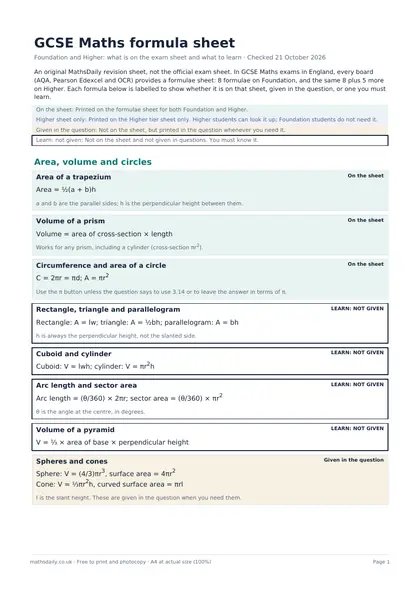
What is on the GCSE Maths formula sheet?
Every board in England (AQA, Pearson Edexcel and OCR) uses the same formulae for GCSE Maths. Foundation students get these 8:
- Area = ½(a + b)h (Area of a trapezium)
- Volume = area of cross-section × length (Volume of a prism)
- C = 2πr = πd; A = πr2 (Circumference and area of a circle)
- a2 + b2 = c2 (Pythagoras’ theorem)
- sin A = opp/hyp; cos A = adj/hyp; tan A = opp/adj (Trigonometric ratios (SOHCAHTOA))
- Total accrued = P(1 + r/100)n (Compound interest)
- P(A or B) = P(A) + P(B) − P(A and B) (Probability: either event)
Higher students get the same 8, plus these 5:
- a/sin A = b/sin B = c/sin C (Sine rule)
- a2 = b2 + c2 − 2bc cos A (Cosine rule)
- Area = ½ab sin C (Area of any triangle)
- ax2 + bx + c = 0 ⇒ x = (−b ± √(b2 − 4ac)) / 2a (Quadratic formula)
- P(A and B) = P(A given B) × P(B) (Probability: both events)
Formulae for the volume and surface area of spheres and cones, and the kinematics equations, are printed inside a question when you need them. Everything else, from the area of a triangle to y = mx + c, you must learn.
How the labels work
- On the sheetPrinted on the formulae sheet for both Foundation and Higher.
- Higher sheet onlyPrinted on the Higher tier sheet only. Higher students can look it up; Foundation students do not need it.
- Given in the questionNot on the sheet, but printed in the question whenever you need it.
- Learn: not givenNot on the sheet and not given in questions. You must know it.
Area, volume and circles
Area of a trapezium
On the sheetArea = ½(a + b)h
a and b are the parallel sides; h is the perpendicular height between them.
Volume of a prism
On the sheetVolume = area of cross-section × length
Works for any prism, including a cylinder (cross-section πr2).
Circumference and area of a circle
On the sheetC = 2πr = πd; A = πr2
Use the π button unless the question says to use 3.14 or to leave the answer in terms of π.
Rectangle, triangle and parallelogram
Learn: not givenRectangle: A = lw; triangle: A = ½bh; parallelogram: A = bh
h is always the perpendicular height, not the slanted side.
Cuboid and cylinder
Learn: not givenCuboid: V = lwh; cylinder: V = πr2h
Arc length and sector area
Learn: not givenArc length = (θ/360) × 2πr; sector area = (θ/360) × πr2
θ is the angle at the centre, in degrees.
Volume of a pyramid
Learn: not givenV = ⅓ × area of base × perpendicular height
Spheres and cones
Given in the questionSphere: V = (4/3)πr3, surface area = 4πr2
Cone: V = ⅓πr2h, curved surface area = πrl
l is the slant height. These are given in the question when you need them.
Pythagoras and trigonometry
Pythagoras’ theorem
On the sheeta2 + b2 = c2
Right-angled triangles only; c is the hypotenuse, opposite the right angle.
Trigonometric ratios (SOHCAHTOA)
On the sheetsin A = opp/hyp; cos A = adj/hyp; tan A = opp/adj
Right-angled triangles only. Check your calculator is in degrees.
Exact trigonometric values
Learn: not givensin 30° = ½, cos 30° = √3/2, tan 30° = 1/√3; sin 45° = cos 45° = 1/√2, tan 45° = 1; sin 60° = √3/2, cos 60° = ½, tan 60° = √3
sin 0° = 0, cos 0° = 1, tan 0° = 0; sin 90° = 1, cos 90° = 0
Needed for non-calculator papers on both tiers.
Sine rule
Higher sheet onlya/sin A = b/sin B = c/sin C
Higher tier. Side a is opposite angle A.
Cosine rule
Higher sheet onlya2 = b2 + c2 − 2bc cos A
Higher tier. Use it when you know two sides and the angle between them, or all three sides.
Area of any triangle
Higher sheet onlyArea = ½ab sin C
Higher tier. C is the angle between sides a and b.
Number, money and compound measures
Compound interest
On the sheetTotal accrued = P(1 + r/100)n
P is the amount invested, r the percentage rate per period, n the number of periods. For depreciation, learn the version P(1 − r/100)n.
Simple interest
Learn: not givenInterest = P × r × t / 100
r is the yearly percentage rate and t the number of years.
Percentage change
Learn: not givenPercentage change = (change ÷ original) × 100
Always divide by the original value, not the new one.
Speed, density and pressure
Learn: not givenSpeed = distance ÷ time; density = mass ÷ volume; pressure = force ÷ area
Check the units match before you calculate.
Laws of indices
Learn: not givenam × an = am+n; am ÷ an = am−n; (am)n = amn; a0 = 1
Higher: a−n = 1/an; a1/n = ⁿ√a
Direct and inverse proportion
Learn: not giveny ∝ x: y = kx; y ∝ 1/x: y = k/x
Find k from one known pair of values first. Inverse proportion equations are Higher tier.
Kinematics
Given in the questionv = u + at; v2 = u2 + 2as; s = ut + ½at2
Higher tier. Given in the question when you need them.
Algebra and graphs
Quadratic formula
Higher sheet onlyax2 + bx + c = 0 ⇒ x = (−b ± √(b2 − 4ac)) / 2a
Higher tier. Rearrange to = 0 before reading off a, b and c.
Straight-line graphs
Learn: not giveny = mx + c; gradient m = change in y ÷ change in x
c is the y-intercept. Parallel lines have equal gradients.
Perpendicular gradients
Learn: not givenm1 × m2 = −1
Higher tier. The perpendicular gradient is the negative reciprocal.
Equation of a circle
Learn: not givenx2 + y2 = r2
Higher tier. Centre at the origin, radius r.
Difference of two squares
Learn: not givena2 − b2 = (a + b)(a − b)
Geometry
Angle facts
Learn: not givenAngles on a straight line = 180°; around a point = 360°; triangle = 180°; quadrilateral = 360°
Vertically opposite angles are equal. Alternate and corresponding angles on parallel lines are equal.
Polygons
Learn: not givenSum of interior angles = (n − 2) × 180°; sum of exterior angles = 360°
For a regular polygon, each exterior angle = 360° ÷ n.
Similar shapes
Learn: not givenLength scale factor k ⇒ area scale factor k2, volume scale factor k3
Area and volume scale factors are Higher tier.
Probability and statistics
Probability: either event
On the sheetP(A or B) = P(A) + P(B) − P(A and B)
If A and B cannot both happen, P(A and B) = 0, so P(A or B) = P(A) + P(B).
Probability: both events
Higher sheet onlyP(A and B) = P(A given B) × P(B)
Higher tier. For independent events, P(A and B) = P(A) × P(B).
Probability facts
Learn: not givenP(not A) = 1 − P(A); probabilities of all outcomes add up to 1; expected frequency = probability × number of trials
Averages and range
Learn: not givenMean = total ÷ number of values; median = middle value in order; mode = most common; range = largest − smallest
Mean from a frequency table = Σfx ÷ Σf
See the mean, median, mode and range guide.
Spread and histograms
Learn: not givenInterquartile range = upper quartile − lower quartile; frequency density = frequency ÷ class width
Higher tier.
Formulae to learn
These are not on the exam sheet. The last page of the PDF has the same list as tick-boxes.
- Rectangle, triangle and parallelogram
- Cuboid and cylinder
- Arc length and sector area
- Volume of a pyramid
- Exact trigonometric values
- Simple interest
- Percentage change
- Speed, density and pressure
- Laws of indices
- Direct and inverse proportion
- Straight-line graphs
- Perpendicular gradients
- Equation of a circle
- Difference of two squares
- Angle facts
- Polygons
- Similar shapes
- Probability facts
- Averages and range
- Spread and histograms
Official sources
Checked on 21 October 2026. Always revise from the sheet your exam board publishes for your exam series.
- Ofqual: decisions on changes to the assessment of GCSE maths, physics and combined science in 2025, 2026 and 2027
- AQA: GCSE Maths and Sciences formulae and equation sheets for 2027 and 2028 onwards
- AQA: GCSE Maths and Sciences formulae and equation sheets for 2026–2027
- AQA GCSE Mathematics (8300) specification: mathematical formulae
- Department for Education: GCSE mathematics subject content and assessment objectives
Use the formulae in practice
Start GCSE daily practice →Common questions
Do you get a formula sheet in GCSE Maths?
Yes. Ofqual confirmed that GCSE Maths students in England get a formulae sheet in the 2025, 2026 and 2027 exams, and AQA has said sheets continue from 2028 as an interim measure until reformed GCSEs arrive. Every board provides a clean copy with each paper.
What is on the GCSE Maths Foundation formula sheet?
Eight formulae: area of a trapezium, volume of a prism, circumference and area of a circle, Pythagoras’ theorem, the three trigonometric ratios, compound interest, and P(A or B) = P(A) + P(B) − P(A and B).
What extra formulae are on the Higher sheet?
The quadratic formula, the sine rule, the cosine rule, area = ½ab sin C, and P(A and B) = P(A given B) × P(B), on top of the eight Foundation formulae.
Which formulae do I still need to learn?
20 of the 34 formula groups on this page are labelled “Learn: not given”, including areas of rectangles and triangles, the cuboid and cylinder, arc length and sector area, angle facts, y = mx + c, speed, density and pressure, and the averages. The last page of the PDF is a tick-list.
Is this the official exam sheet?
No. It is an original MathsDaily revision sheet that shows what the official sheet contains and what it leaves out. In the exam you use the copy your board supplies.